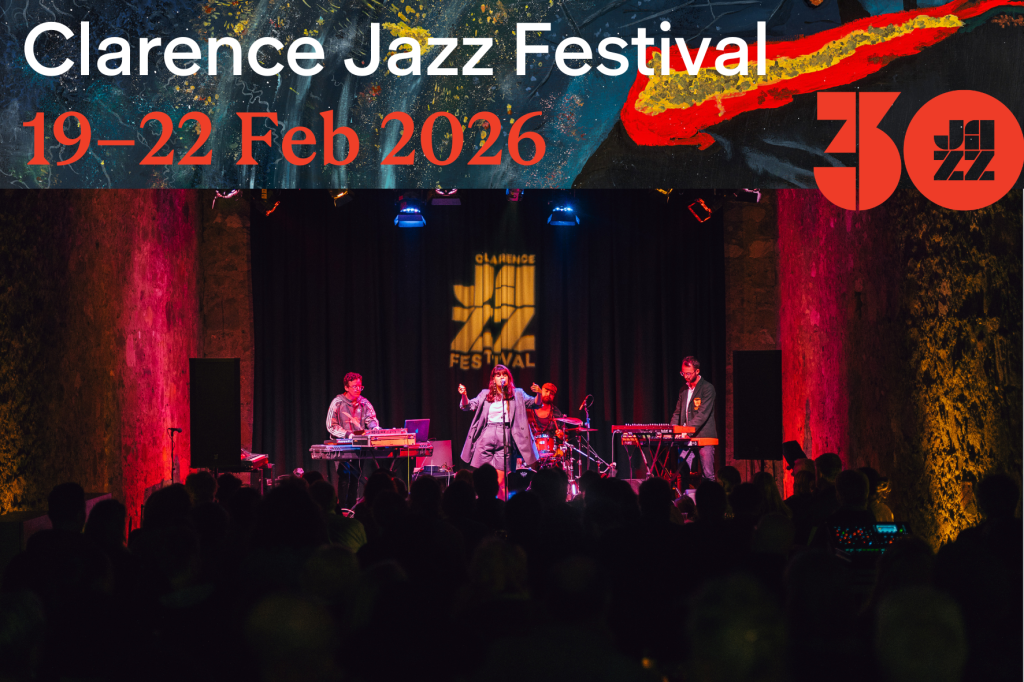
Sixteen composers. One place. A whole new sound for Lutruwita/Tasmania.
We’ve brought together the biggest group of jazz composers ever assembled in Lutruwita to create brand-new music for the Clarence Jazz Festival’s 30th year – Elly Hoyt, Sandesh Pariyar, Kelly Ottaway, Spike Mason, Louise Denson, Lila Meleisea, Ian Chia, Louis Monaghan, Jesse Bowden, Matt Boden, Karlin Love, Ade Ishes, Sasha Gavlek, Erin Sherlock, Madelena Anderson Ward, Dewayne Everettsmith and Harry Edwards.
Each artist brings with their unique background, culture and lived experiences — and collectively, their work reflects the people and the Country we stand on.
They’ve spent the last nine months writing music shaped by this place, this is the first chance to hear what they’ve made.
Artist statements
Ade Ishs: Alive
My musical compositions are often visceral. There is an emphasis on emotional impact rather than technical prowess demonstration. My philosophy in music-making is that it is about the music, not the people making it.
My submission for the debut iteration of the Clarence Composers Collective is titled Alive, and it was inspired by the concepts of life and emotion. Therefore, it serves as a vehicle for exploration of such themes.
The main source of inspiration of my composition (although the final piece does not contain/prescribe it) is a part of liturgical chant originating in Central Asia and also preserved by the Naqshbandi Sufi Order. The relevant part is a repetition of the word حي (romanised as ‘hayy’, pronounced like the English ‘hi’) which translates to ‘alive’ in English.
To translate the abstract concept of life into a tangible expression, I had in mind breath as a vital life force. When writing the music, I put that philosophy into work by including ‘breath elements’. In particular, I had Elly Hoyt’s beautiful singing voice and Spike Mason’s illustrious saxophone playing in mind. This by no means implies that other instruments that do not depend on wind for sound generation are not alive. I feel that they are less direct compared to the ‘breath’ instruments. The sense of breath is achieved through melodic phrasings.
Enhancing the emotional aspect of the piece, the arrangement for Clarence Jazz Festival 2026 incorporates my signature sonic drama, making use of orchestration layers from the instruments. In my approach to instrumentation, I do not classify instruments into front-line and background ones. Rather, roles can shift in various parts of a piece. For example, in this arrangement, the first part features the traditional jazz vocal instrumentation with the vocalist as the front line. In the second part, the vocalist shifts to a supporting role in the sax solo section.
Ultimately, I wish to include the audience and fellow performers in this journey to experience the emotional energy. Starting from the poignant yet hopeful first part, the listeners are transitioned to the dark and harsh bridge. The sax solo section with the groovy rhythm signifies a motion towards positivity and liveliness, climaxing in the outro with vocal and sax melody lines harmonising with each other.
I hope that at the end of the listening experience, both the audience and performers feel a heightened awareness of their surroundings, appreciating the life around them, and feeling at peace with each other and the reality shared together.
Elly Hoyt: How Far We’ve Come
How Far We’ve Come was commissioned for the 2026 Clarence Jazz Festival as part of the Composer’s Collective. The work is written from the perspective of my younger self, standing at the beginning of my journey as a jazz vocalist, playing in the Tattersalls Youth Big Band and entering The Clarence Jazz Festival Scholarship program almost twenty years ago.
The piece traces an arc from youthful trepidation and ambition to a deeper sense of strength and belonging. I wanted to capture the uncertainty, determination, and persistence it takes to remain in this industry, and how those early experiences quietly shape who we become as artists. Musically, the work reflects this growth over time, with excitement but tentative beginnings gradually giving way to confidence, resilience, and clarity.
To be performing this piece now as a regular artist at the Clarence Jazz Festival, and doing so at the first jazz festival I ever played, is deeply meaningful. It feels like a full circle moment and a celebration of the extraordinary musical community that has supported and nurtured me along the way.
This work is a testament to the power of place and community, and to the artists, mentors, and peers who make it possible to grow, endure, and keep showing up. I am proud to be sharing How Far We’ve Come here in Nipaluna / Hobart, Lutruwita.
Erin Sherlock: Morph
Having played at the Clarence Jazz Festival for almost a decade, and been in attendance for longer, I want to acknowledge how the festival has progressed and how it’s truly come into its own over the years. I reflected on some of the projects that I’ve been fortunate to be a part of and the people I’ve met through the festival. I want this composition to encompass the joy I feel being with these people both on stage and off and well as a sense of hope for all the projects and new people to come.
This composition is written for Stevie, Bec and the Clarence team, as well and the musicians and listeners who support music and make choices that lift the standards for inclusivity and diversity in our music community.
Harry Edwards: Non Dual
This track Non Dual has been written primarily as a sentimental reflection on the intrinsic interconnectivity of people and place, and how this connection with each other and our environment is fundamental to our health. I also sought inspiration sentiment-wise by reflecting on my core values of cultivating community well-being, my interest in meditation, and my appreciation for the local music scene in beautiful nipaluna.
During development I spent time remembering the opportunities I’ve had to play at the festival in the past, including launching my first record there in 2015, and the feeling of gratitude I have for that. I have also reflected on which Tasmanian / lutruwita artists have influenced me the most, with particular attention to the 2011 album 1234 recorded by bassist/composer Nick Haywood during his time living in Hobart, which came out at a formative time for me at the end of my UTAS jazz studies.
Holding the above sentiment soup, I began scrapbooking some ideas, mostly chord progression fragments including Major I to minor iv shifts and minor chord tritone shifts. After that the melody fell out pretty quickly, and I mapped on some harmony that felt right. The tune ended up quite long, in AABAA, with a 16 bar A section and a 32 bar B section. I decided to employ the tactic of trimming the tune back as much as possible while trying to keep the intended sentiments intact. In the end I dropped the B section entirely and decided on a simple AA statement of the 16 bar melody, followed by improv over the repeating form, and AA again with the melody on the way out, with player discretion to just do the one A if that feels right in the moment.
Ian Chia: Luck on Our Side
Thirty years ago, a spark was struck by the river’s edge. In 1996, Marjorie Luck OAM, Clarence City Council’s then Community Arts Officer – fuelled by a shoestring budget and a wealth of vision – joined forces with Ian and Marion Pearce. What began as a modest series of jazz concerts by the water has flourished into the vibrant, multi-day celebration that pulses through our city.
‘Luck on Our Side’ is a sonic tribute to those beginnings. At the heart of this piece are the voices of Marjorie Luck and Wendy Moles, captured in a 2015 interview about the festival’s birth.
I have treated their spoken words not just as history, but as music. The natural cadence of their laughter, the rhythm of their memories, and the melodic rise and fall of their storytelling serve as the literal foundation for the composition. Their voices shape the melodies and drive the rhythms, mirroring the joyous complexity of building something from nothing.
As we celebrate this 30th anniversary, this work invites you to listen to the DNA of the Clarence Jazz Festival – a journey from a concert by the water to the rich, harmonic tapestry we all share today.
Thank you very much, Marjorie.
Thank you very much.
Jesse Bowden: Remember Where the World Slows?
This musical work was commissioned by the 2026 Clarence Jazz Festival as part of the Clarence Composers Collective. The piece draws inspiration from an emotional experience many people are familiar with, even if the details differ – that point where life has piled up so subtly and completely that you didn’t notice how far you had drifted from yourself.
For one of the Composers Collective meetings, we were going to walk the takara limuna, a local trail honouring the stories, history, and culture of the Mumurimina people. Unfortunately, we didn’t end up walking the track, so I decided to take my saxophone there myself in search of some ‘inspiration’ for my piece.
I sat at the central firepit for hours, recording fragments, waiting for something to land. Nothing did. My mind kept circling back to lessons I needed to plan and assignments I hadn’t started. Eventually, defeated, I put the horn away and decided to explore the track.
What happened during that walk wasn’t dramatic; it was a subtle shift, the kind you only notice after it has already happened. Reading the stories, feeling the presence of my people, and being held and nurtured by Country reminded me of what I had forgotten: that grounding isn’t an escape from life; it’s a way back into it. And when it arrives, the world slows down enough for you to feel human again.
The piece sits in that space where stress loosens its grip and you reconnect with whatever steadies you, be it culture, memory, place, people, or something else – and in that moment, you feel a quiet, unmistakable lightness.
Remember Where the World Slows? isn’t just my story. It’s an invitation for anyone to reflect on whatever it is that slows down their world, and brings them back to themselves.
Karlin Love: Trumanya Payna, Piyura Kitina, Tintumilli Minanya
In celebration of the Clarence Jazz Festival’s 30th anniversary, I have set three palawa kani Clarence-area place names to music. The Festival is a local program and I want to highlight that this is a place in which people have gathered and shared their stories and art for millennia. European colonisers’ names for these places reflect a much shallower (if any!) sense of community and country. Since I am a recent immigrant, using palawa kani place names feels to me to be more honest and honouring. Singing the names imprints them in our memories and vocabulary. The melodies are derived from recordings on the Tasmanian Aboriginal Centre’s palawa kani Language Program’s map of place names (link via the QR code).
Trumanya Payna: Kangaroo Point
Piyura Kitina: Risdon Cove
Tintumili Minanya: Derwent River
This work was created with leather sculptural instruments by the late Tasmanian artist, Garry Greenwood. These exquisite instruments have inspired much creative music-making over the past 30 years, a fitting collaboration for this celebration.
The overall vibe is joyful – because the majority of the past was in balance and positive, and steps are being taken toward a positive future. However, there is also a darker tone, acknowledging the horrors of invasion. I know all these places were soaked in blood by colonisers. I am sorry. I offer this piece in hope and commitment to working for that positive future.
Karlin Love
‘In palawa kani, the language of Tasmanian Aborigines’.

Link to the Tasmanian Aboriginal Centre website map
Lila Meleisea: Lumi Echoes
Lila Meleisea is a Tasmanian-Samoan interdisciplinary artist. Her research-led practice explores the intersections of traditional knowledge, music, visual art, acoustic ecology, community, and environment. Within the sonic realm, she is interested in how sound can articulate relationships with environment, language, and memory, and how deep listening and responsive engagement can become acts of respect and reciprocity.
Lumi Echoes is a work grounded in remembrance, presence, and relationship with the ancestors of the mumirimina—the original people of the land on which the Clarence Jazz Festival takes place. My creative process was shaped through time spent at Risdon Cove / Piyura Kitina and Takara limuna (Sheoak Walk), sites that hold layered cultural, spiritual, historical, and ecological significance.
Lumi is a palawa kani word meaning here. The idea of here sits at the centre of this composition: an acknowledgement of being present within intersecting histories, languages, and environments. Created in relation to mumirimina Country, the work responds to the understanding that sound is inseparable from place, and the voices heard carry and reveal our connections to Country. Lumi is also a reminder that here—wherever that may be—is the only moment we truly have, much like now. Field recordings made at Piyura Kitina and Takara limuna are woven throughout the work, allowing the voices of these places to shape how sound maps presence, belonging, and attentiveness. Lumi Echoes is an invitation to engage deeply with the act of being here: to experience music not only as an auditory event, but as a shared moment of relationship with place and its enduring stories.
Echoes speaks to the presence of the past as it is acknowledged in the here and now. Another sound source in the work comes from the remnants of sound sculptures created by Nunami Sculthorpe-Green, a Palawa and Walpiri woman. She created two sculptures positioned on these two sites, designed so that the voices they produced would call to one another—connecting the two places through sound. By working with the remnants of these sculptures, I continue their sonic life. While they are used in a different way, their voices remain—echoing and honouring their past, and held and played by those who care. The sculptures also carry imprints taken from an ancient local Aboriginal cave and native flora. Through this, the voices generated with them resonate far beyond the present moment, echoing back to pre-colonial times and acknowledging the rich, abundant life of palawa people prior to invasion and the violence of European settlement.
Instrumentation and Practice The work also integrates the recorded voices of birds, plants, shells, and wind from both Piyura Kitina and Takara limuna, acknowledging both the balance of the natural world and my deep care for it. My practice is grounded in working with nature as a collaborator—not merely drawing inspiration from it, but actively engaging in the moment as an integral part of it. Being part of these environments, listening to them, and responding directly to them informs the way I create. Through these materials and relationships, Lumi Echoes seeks to reflect and honour the continual exchange between human, ecological, and cultural presences of place—an exchange that exists beyond Western notions of linear time and continues to resonate through Country.
Finally, this project has been pivotal in my own practice, urging me to weave together my past and present.. It has drawn me back to my identity as a saxophone performer—a part of my path I had set aside. In Lumi Echoes, I inhabit this role once again, bringing the baritone saxophone into dialogue with my evolving practice, letting the instrument speak both memory and discovery.
Matt Boden: East Derwent Highway Toodle-oo
Movements: 1. Strut / 2. Stomp / 3. Wail
This work, commissioned for the 2026 Clarence Jazz Festival as part of the Composer’s Collective, has three main strains of inspiration.
The first is the great musicians who were instrumental in the origins of the Tasmanian, and indeed Australian, Jazz scene – particularly Ian Pearce and Tom Pickering and their associated cohort. These trail blazers, through a combination of ‘imitation-ecstatic’ performance practice, countless hours of dedicated listening and absorption, and a devil-may-care approach to getting the music out there, formed part of the genesis of the entire landscape of jazz in Australia alongside the likes of Graeme Bell, Dave Dallwitz, The Red Onions, et al. I actually cared enough about this to do a PhD on the topic – have a read if you’re having trouble sleeping.
The second is the incredible group of friends and musicians (the two groups are not necessarily mutually exclusive) who have inspired me since I began dealing with the wonderful art form of Jazz and continue to propel me forward into the never-ending delight that is this music. They have appeared from all walks of life – local, national, international – in un-looked for moments, and in humbling surprises. I am eternally grateful for the love and the trust. The title of this work is directly related to John Scurry’s wonderful tune ‘East St. Kilda Toodle-oo’, which in itself is a reference to ‘East St. Louis Toodle-oo’ by Louis Armstrong and Bubber Miley – I think you can see where this is coming from (my paternal grandmother also lived for a while on East Derwent Highway, directly across the road from Ian Pearce … Tasmania, eh?). John is a dear friend and an incredible musician – he has been a stalwart of the Australian Jazz scene since time immemorial, and I am incredibly grateful to be a part of his group Reverse Swing – John’s approach, joyous swing feel and language, and irrepressible spirit are part of the fabric of this work and indeed my approach to Jazz in general. As well as John, this work is dedicated to all of us (you know who you are) who are committed to the spirit of this wonderful and ineffable music. As Allan Browne said: “Those who go for it are doomed to ecstasy.”
Finally, and perhaps most importantly, this work is deeply inspired by Duke Ellington. There aren’t adjectives in any language worthy enough of Duke, so I’ll leave it there.
Sasha Gavlek: Wither
Pondering on connection to earth, connection to country.
I have found myself disillusioned with the world as of late, angry and despondent at the lack of justice, and a collective apathy towards violence that is seeming to grow every day. I don’t know what to do with these feelings.
Like most folks, being in nature is grounding. Especially when I am experiencing terrifying bouts of depersonalisation.
I find comfort in the thought that all the tyrants of the world will eventually end up in the same place as me, as all of us; Dead in the ground. Feeding the soil and the insects. The apathy has spread to me as well.
The lyrics in this piece are death personified. I like that you can interpret the words as comforting, or disturbing, depending on your outlook.
There is a push and pull of tension and uncertainty in the chords throughout, reflecting both sides of the coin of nihilism with the notions of “nothing matters, hooray!” and “nothing matters, oh god!”
The piece ends in a more upbeat tone, perhaps reflecting my desire for positive change, propelled by our actions. I want to fight for it.
Spike Mason: 76 @ 3am Quest
Most recently, after 40 years of composing, I seem to be leaning toward not judging what I write anymore. I guess I mean I’m not trying to write anything “good” but just what comes out first take – no editing. Trying to just accept all the bits as they arrive in my brain.
It feels more honest to musically reflect the daily confusion I experience in every part of my life.
I was arriving after a gig in the dark to an unknown camping area and got terribly lost…
This commission is supported by Festivals Australia.
Performing at the Opening Party, Big Day at the Park, Closing Party
Thursday 19 Feb | 6.45pm
Lawn Stage
FREE
Saturday 21 Feb | 3pm
Park Stage
GET TICKETS
Sunday 22 Feb | 2.40pm
Lawn Stage
FREE
It’s our 30th. And everyone’s invited.
The Clarence Jazz Festival is celebrating 30 years of good times, sunshine, and staying up too late with a bumper program of live music at Rosny Farm.